
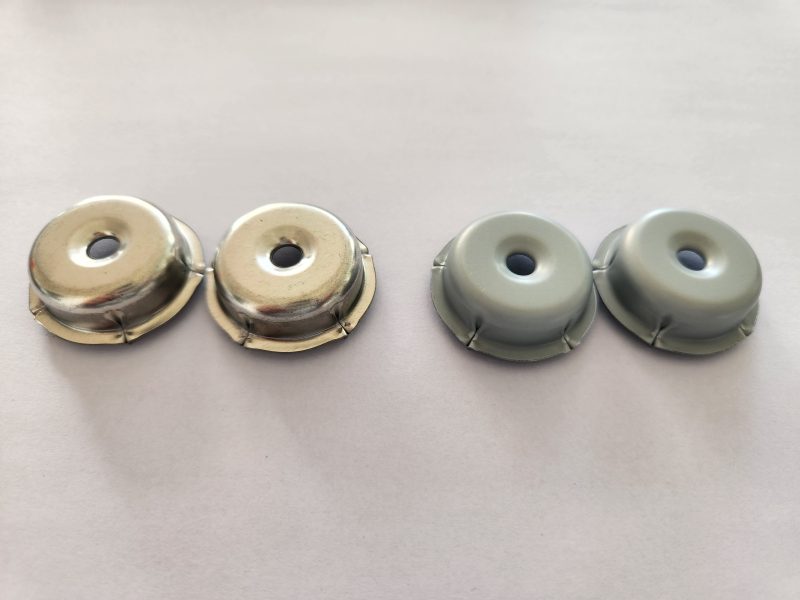
The Role of Gasket Design in Preventing Gas Leakage from Paint Containers
Paint containers, whether used in industrial settings or consumer applications, must maintain airtight seals to prevent volatile organic compounds (VOCs) and other gases from escaping. These emissions not only pose environmental and health risks but also lead to product degradation. The effectiveness of a gasket in this context depends on material selection, structural engineering, and installation precision. Below, we explore how these factors contribute to reliable gas containment.
Material Selection for Chemical Resistance
The primary function of a gasket is to resist degradation when exposed to aggressive chemicals. Paints often contain solvents like acetone, toluene, or alcohols, which can corrode or swell inferior materials. For example, nitrile rubber (NBR) is widely used for its balance of oil resistance and flexibility, making it suitable for sealing containers holding solvent-based paints. In contrast, fluorocarbon elastomers (e.g., Viton) excel in high-temperature environments or when exposed to aromatic hydrocarbons, offering superior longevity.
Silicone gaskets, while less chemically resistant than NBR or Viton, provide excellent thermal stability and are ideal for water-based paints stored at elevated temperatures. The choice of material must align with the paint’s composition and storage conditions to prevent premature failure. A mismatch, such as using NBR with ketone-based solvents, can lead to swelling, cracking, or loss of compression, compromising the seal.
Structural Engineering for Compression and Adaptability
A gasket’s ability to maintain a seal under varying pressures and temperatures hinges on its structural design. Many modern gaskets feature ribbed or contoured profiles that enhance flexibility, allowing them to conform to irregularities in container lids or flanges. For instance, a profiled gasket with multiple sealing ridges can distribute compression more evenly, reducing the risk of localized leaks.
In high-pressure applications, such as industrial paint drums, spiral-wound gaskets combine a metallic core with a soft filler material to balance strength and adaptability. The metal provides structural integrity, while the filler ensures a tight seal against rough surfaces. This dual-material approach is particularly effective in preventing interstitial leakage, where gases escape through microscopic gaps in the gasket material.
Another critical design consideration is the gasket’s thickness and hardness. Overly thick gaskets may resist compression, leaving gaps, while excessively hard materials may crack under stress. Engineers often use Shore hardness scales to select materials that deform just enough to fill voids without losing resilience.
Installation Techniques to Maximize Seal Integrity
Even the highest-quality gasket can fail if installed incorrectly. Proper alignment between the gasket, container, and lid is essential to prevent surface leakage, where gases escape around the edges of the seal. Many gaskets incorporate alignment features, such as locating pins or raised edges, to simplify installation and ensure consistent positioning.
Torque specifications for lid fasteners also play a pivotal role. Under-tightening leaves gaps, while over-tightening can crush the gasket or warp the container, new leakage paths. Automated torque-control systems in industrial settings help standardize this process, but manual applications require careful calibration.
Environmental factors during installation, such as temperature and humidity, can affect gasket performance. Cold temperatures may stiffen elastomers, reducing their ability to conform, while high humidity can interfere with adhesive backings on self-sealing gaskets. Storing gaskets in climate-controlled environments prior to use mitigates these risks.
Advanced Solutions for Critical Applications
In scenarios where gas leakage must be minimized—such as in aerospace coatings or hazardous material storage—specialized gaskets with redundant sealing layers are employed. Double-jacketed gaskets, for example, feature an inner core surrounded by two sealing elements, providing fail-safe protection. Some designs even incorporate visual indicators, such as color-changing layers, to alert operators when compression is lost.
For reusable containers, removable gaskets with quick-release mechanisms simplify maintenance without compromising seal integrity. These gaskets often use snap-fit or compression-fit designs that allow for easy replacement while maintaining precise alignment.
Conclusion
Preventing gas leakage from paint containers requires a holistic approach that integrates material science, structural engineering, and precise installation. By selecting chemically resistant materials, optimizing gasket profiles for compression, and adhering to rigorous installation protocols, manufacturers can ensure airtight seals that protect both products and the environment. As regulations on VOC emissions tighten, the role of advanced gasket technologies will become increasingly critical in sustainable paint storage and transportation.